Lemež Farm increased milk production by 40% in six years through improvements and smart collars
Published: 3/16/2026
Lemež Farm increased milk production by 40% in six years through improvements and smart collars.
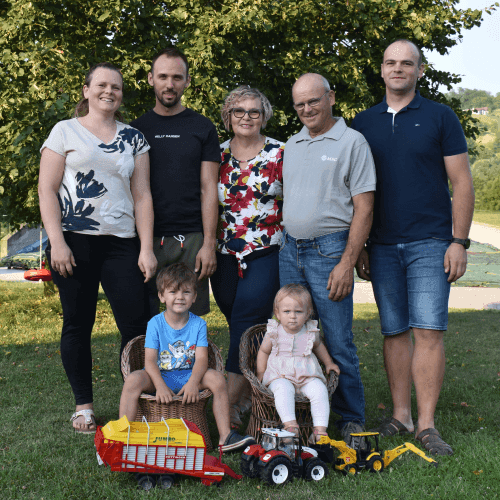
A Family Farm now in its fifth generation. On the outskirts of Maribor, in Zrkovci, the Lemež family farm is now successfully run by the fifth generation. Lea Lemež Bohak manages the farm together with her mother Danica and father Ciril. An essential part of the team are also her husband Boštjan and brother Boštjan. Together, they raise around 100 head of cattle, milking up to 45 cows daily. Their teamwork ensures that all key processes on the farm – from insemination to hoof trimming – are performed timely and with quality.
Fleckvieh Dual-Purpose Breed as the Foundation
The Fleckvieh breed, which they’ve raised from the beginning, remains the core of their herd.
The breed is highly adaptable, healthy, and resilient, which allows cows to stay in the herd longer. On top of that, it provides high milk quality and good meat yield, which is a big advantage for us.
Although it’s a dual-purpose breed, the emphasis is on milk – about 400,000 kg per year. They also process some of their milk in their own dairy, producing soft cheeses, cottage cheese, yogurt, and skyr.
The versatility of the dual-purpose breed provides not only milk but also high-quality male calves, which grow well and are sold at about three weeks old. By improving both physical and productive traits, especially longevity, they achieve a better herd renewal rate. This enables them to sell more heifers for breeding purposes, while providing buyers with all essential data on health and productivity – including bacteriological test results.
A bacteriological analysis is done on the entire herd once a year, and throughout the year, all heifers and cows before drying-off are additionally tested. This helps them maintain a healthy herd and high-quality milk and sell verified, healthy animals to other farmers.
From 6,600 to 9,200 kg of Milk in Six Years
In 2018, they set a clear goal – to increase milk production. The result was not due to a single change, but rather gradual and coordinated improvements across several areas. Milk yield is influenced by genetics and many environmental factors – especially nutrition, housing conditions, and the farmer’s decisions. They first focused on optimizing feed and diet quality. Introducing a wall film significantly reduced fermentation losses and improved silage quality.
They also put great emphasis on genetics to improve breed purity and traits of the Fleckvieh. Through selection and planned insemination, they gradually reduced the share of Red Holstein genes and increased Fleckvieh representation in the herd. Today, they are very close to a fully purebred Fleckvieh herd, which brings better productivity, longevity, and durability.
In pursuit of more control over processes like selection and animal health, they began doing their own inseminations and more recently also hoof trimming. They modernized the barn’s conditions and technology, switching from traditional fans to a tube ventilation system, and in 2023 they introduced robotic milking.
Data – The Key to Success
Even though improvements in genetics, nutrition, and technology were essential, the Lemež family emphasizes that data is what allows them to make quick and accurate decisions. As early as 2020, they started exploring digital solutions for monitoring individual cows and the entire herd. Initially, their main motivation was more efficient heat detection. But they soon realized that monitoring rumination was just as crucial, as it strongly affects milk production, animal health, and welfare.
After evaluating various options, they decided this spring to adopt MooHero smart collars. The system doesn’t just help with heat detection but also identifies health issues based on drops in rumination. It also allows them to monitor recovery after illness, predict upcoming calvings, and track animal health. The app also manages reproduction data, including inseminations, which are automatically reported to the CPZ Govedo system, significantly simplifying administration and eliminating double work.
What we love most is that MooHero monitors the cows instead of us – 24/7.
MooHero’s digital solution works by detecting behavioral and physiological changes in individual animals. With sensors and algorithms, the system automatically detects anomalies and notifies the farmer – often before they are even noticeable, resulting in more accurate and timely responses, better animal health and welfare, and stronger economic performance.
Even though they have cameras installed, they rely mainly on data and graphs from the system, comparing them with robotic milking results to get the full picture for fast, effective decision-making.
A Combination of Experience, Technology & Precision
Lemež Farm proves that with persistence and thoughtful steps, it's possible to significantly increase milk yield, improve animal health and welfare, and boost the farm’s profitability – by combining long-standing experience, modern technology, and precise data monitoring.